


Käringsund Game Safari – Guided tour by tractor & wagon



Käringsund Game Safari – Join a unique animal experience on Eckerö, Åland
Our comfortable safari wagon seats about 40 people and takes you on an unforgettable guided tour of our 34-hectare game park, along a hilly track, through forest, out onto meadows and around lakes.
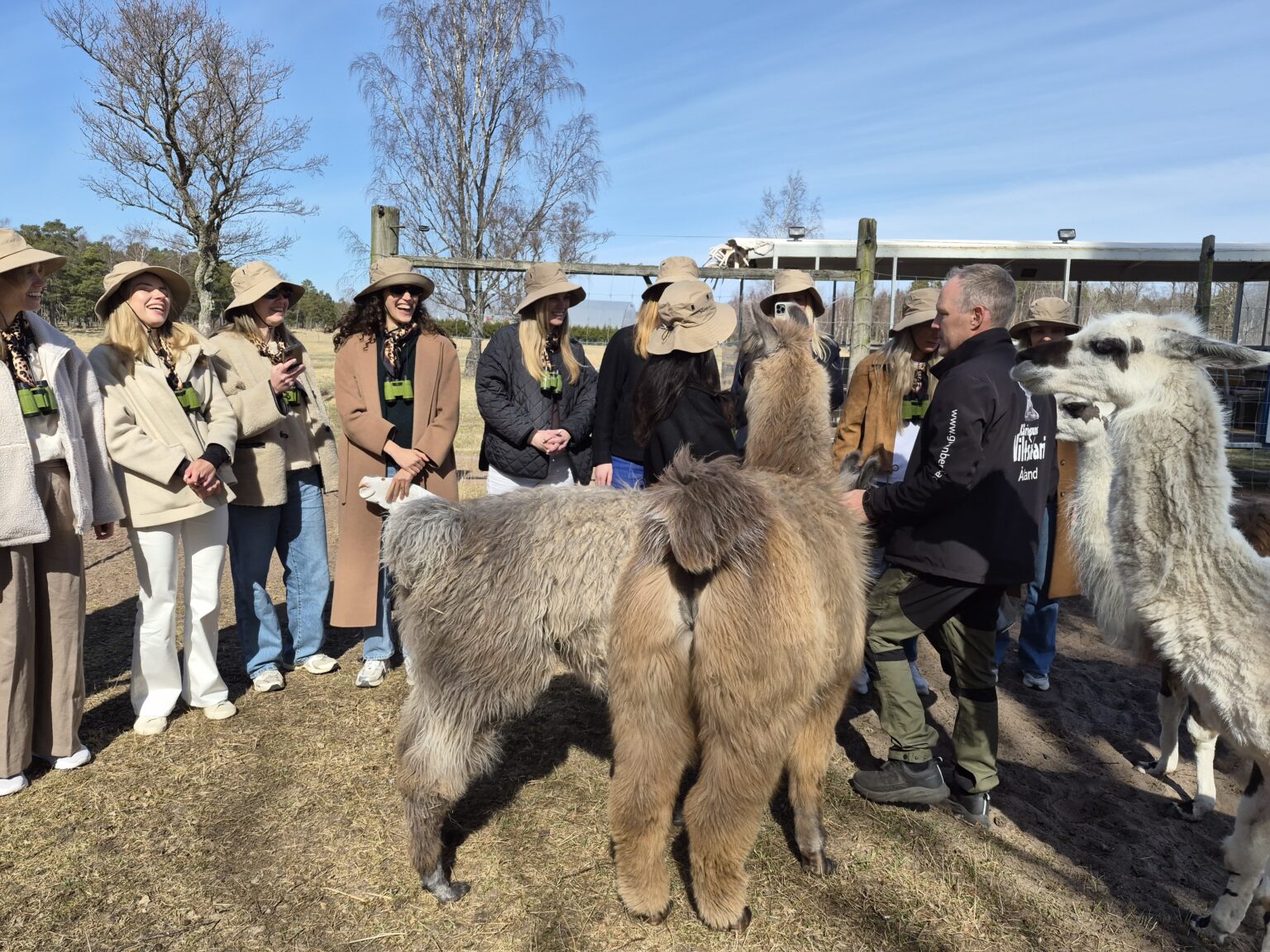
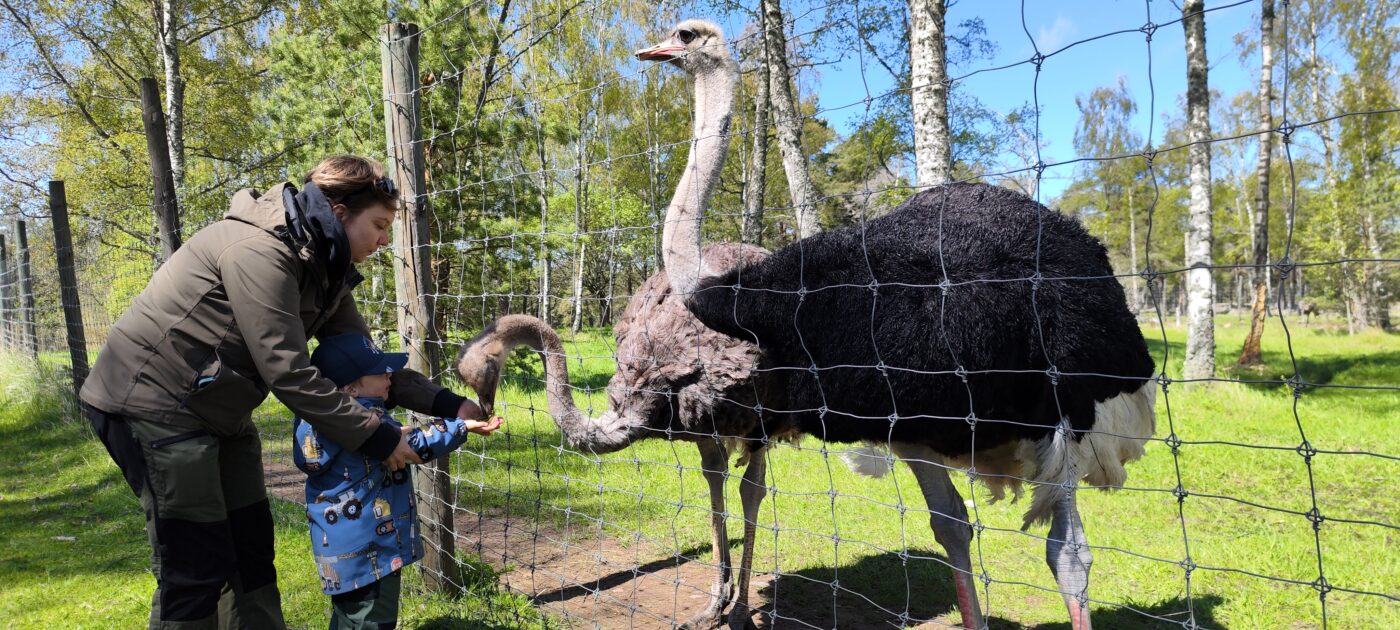
Here you will see red deer, wild boar, ostriches and llamas. With a bit of luck we will also catch a glimpse of fallow deer. During the tour we stop to call the animals over, so you can experience them really close up and in a unique way while learning more about how they behave. You even get to feed several of them yourself!
The safari takes about 45 minutes and starts near the Hunting and Fishing Museum in Käringsund, Eckerö.
Timetable 2027 – Käringsund Game Safari
| 11.6 – 24.6: | 11.00, 12.00, 13.00 daily |
| 25.6: | Closed on Midsummer Eve |
| 26.6 – 7.8: | 11.00, 12.00, 13.00, 14.00, 15.00 daily |
| 8.8 – 14.8: | 11.00, 12.00, 13.00 daily |
Times are subject to change.
For opening times outside our regular timetable, please see our Facebook page or Instagram.
Price list 2027
| Adults: | 18€ |
| Children 7–14 years (accompanied by parents): | 14€ |
| Children 3–6 years (accompanied by parents): | 9€ |
| Children under 3: | free |
| Groups (minimum 16 people): | 16€ / person |
| School groups (minimum 16 people): | 14€ / person |
Safari shop
In our small shop we sell coffee, soft drinks, ice cream, sweets and souvenirs. You can also buy cuddly-toy versions of our animals and our popular locally produced meat products, such as deer sausage, smoked deer and wild boar meat, ostrich eggs and deer antlers.
Groups, school classes & events
Outside the regular timetable we are happy to take group bookings from April to October, weather permitting – for birthday parties, hen parties, company events, or why not a private tour with a little extra time and a chance to get even closer to the animals?
Contact & booking
Individual visitors do not need to book in advance. If you are a larger party or would like to make a group booking, you can easily book ahead by e-mail, Facebook Messenger or by calling us.
E-mail: viltsafari@aland.net
Safari shop (during opening hours): +358 457 3460060
On-call number: +358 457 3435996
These are the animals you can meet on the safari:
Red deer
The red deer is the world’s third-largest deer and the proud provincial animal of both Åland and Skåne. It is an impressive animal: a fully grown stag measures between 175 and 225 cm from nose to the base of the tail, with a tail of about another 15 cm. The shoulder height is a solid 130 to 160 cm, and an average stag weighs around 200 kg. The female, called a hind, is considerably smaller and weighs roughly half as much as the male.
In our park they live in surroundings that resemble their natural habitat, feeding mainly on grass, herbs, leaves, twigs and buds. Depending on the season they also enjoy mushrooms, beech nuts and acorns, as well as bark, especially from spruce and beech.


Fallow deer
The fallow deer is a strikingly beautiful deer, noticeably smaller and more slender than its relative the red deer. The species originally comes from the warm Mediterranean region, but over the centuries it has spread widely in the wild across central Europe and the Nordic countries. In our park it has adapted remarkably well to the Åland climate.
A fully grown buck usually weighs around 100 to 120 kg, while the much smaller females, called does, weigh between 60 and 80 kg. Unlike many other deer, the fallow deer is mainly a grazer and leaf-eater that loves to feed in open areas.
Wild boar
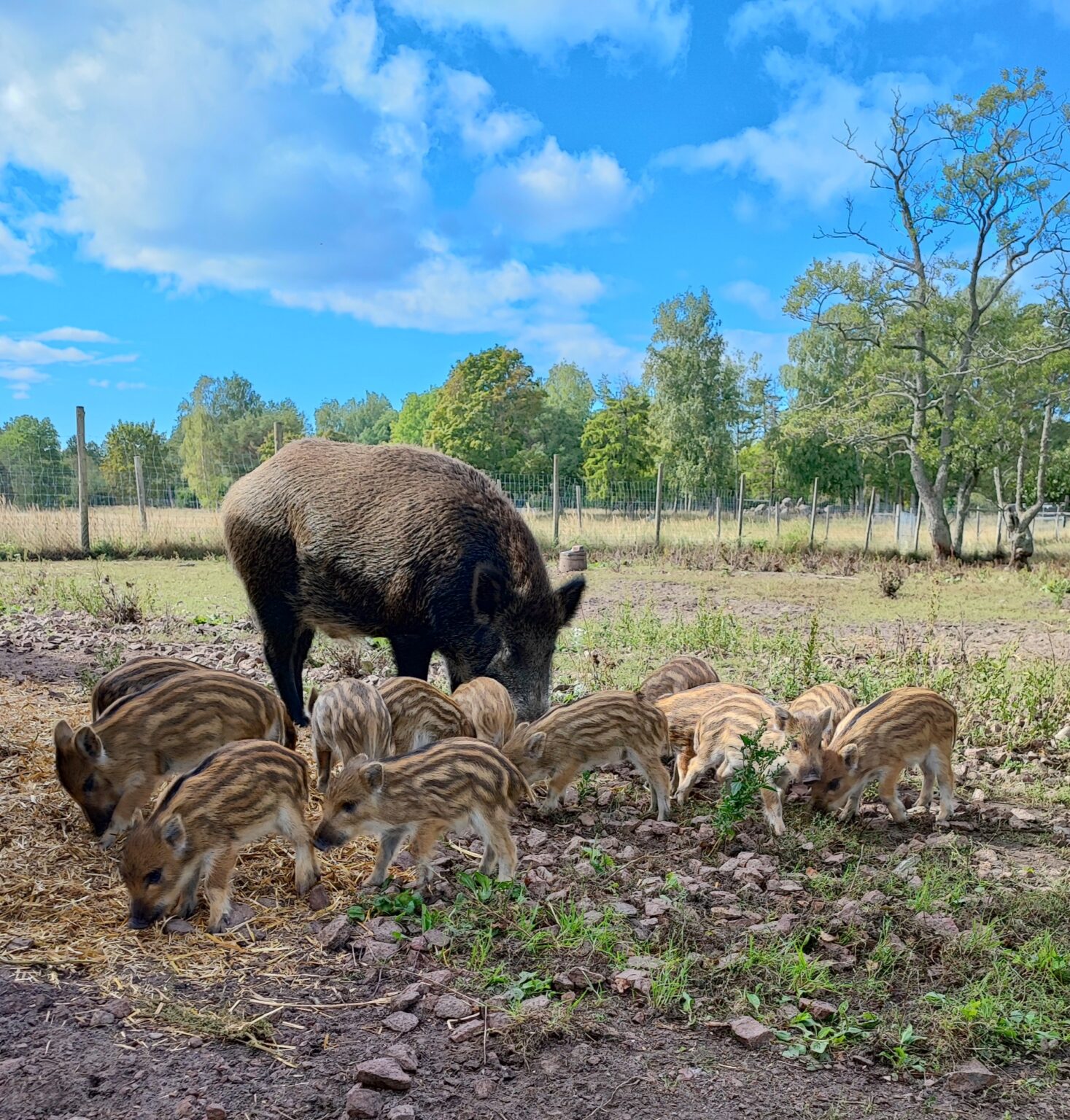
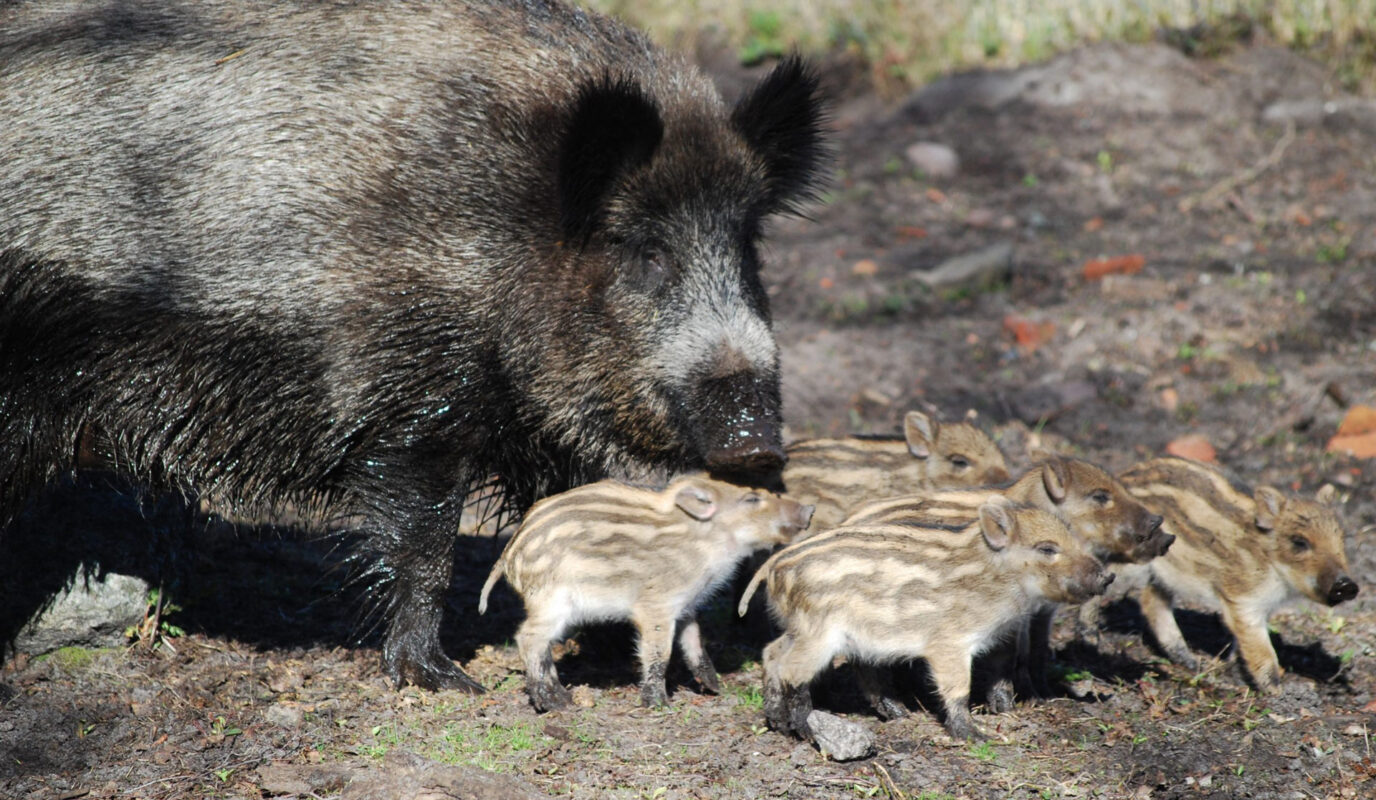
The wild boar is a fascinating even-toed ungulate of the same species as the domestic pig. Its eyesight is quite poor, but it makes up for this with excellent hearing and an extremely sensitive sense of smell – in fact, it can smell a person almost a kilometre away if the wind is right!
In our park the wild boar eat 90 % plant food, although in the wild they are omnivores. A fully grown male (boar) can weigh up to 225 kg and stand about one metre at the shoulder, while the sow (female) is much lighter at between 70 and 140 kg.

Ostrich
The ostrich is a very large, long-legged and long-necked bird that originally comes from Africa. It is the largest living bird in the world and is known for laying the very largest eggs in the animal kingdom. Although the ostrich cannot fly, it is an incredible runner that can reach impressive speeds of up to 65 km/h.
A fun anatomical fact is that ostriches have very small brains, weighing only about 40 grams. In our park they feed mainly on various parts of plants, but they happily add insects, worms and larvae to their diet as they peck around on the ground.
Llama
The llama belongs to the camel family and comes from the mighty Andes in South America. It is easy to recognise by its long ears and proud neck. Unlike camels and dromedaries, the llama has no humps at all. Under its feet it has supple pads, and its upper lip is uniquely split into two movable parts. The llama has wonderfully soft wool that is used, among other things, for warm clothing.
What the llama is perhaps best known for is spitting when it feels threatened or irritated. It is worth knowing, though, that llamas very rarely spit at people – it is rather a way of communicating and asserting their place in the hierarchy among the other llamas in the park!
